

Data Centers, Tech Volatility, and the Midterm Election Results
November 10, 2026

Matt Sweeney, CFP®
Founder, Investment Manager
The stock market has swung in both directions in the days following the midterm election, driven primarily by technology and AI-related stocks. For financial markets, perhaps the most closely watched issue is the outlook for data center construction.
This is because the buildout of data centers has been a significant driver of economic activity and corporate profits as companies set up the infrastructure needed for AI applications. The midterm election results and related ballot measures suggest that voters are in favor of restricting this construction across all levels of government.
These developments add to pressures on technology stocks, which have contributed to portfolio returns in recent years but are also facing questions about valuations, interest rates, and whether large AI infrastructure buildouts will pay off. At the same time, volatility in these parts of the market is normal, and returns have been strong over longer time horizons. What do the latest election results mean for markets, and how can investors maintain a broader perspective?
Voters largely sought to restrict data centers
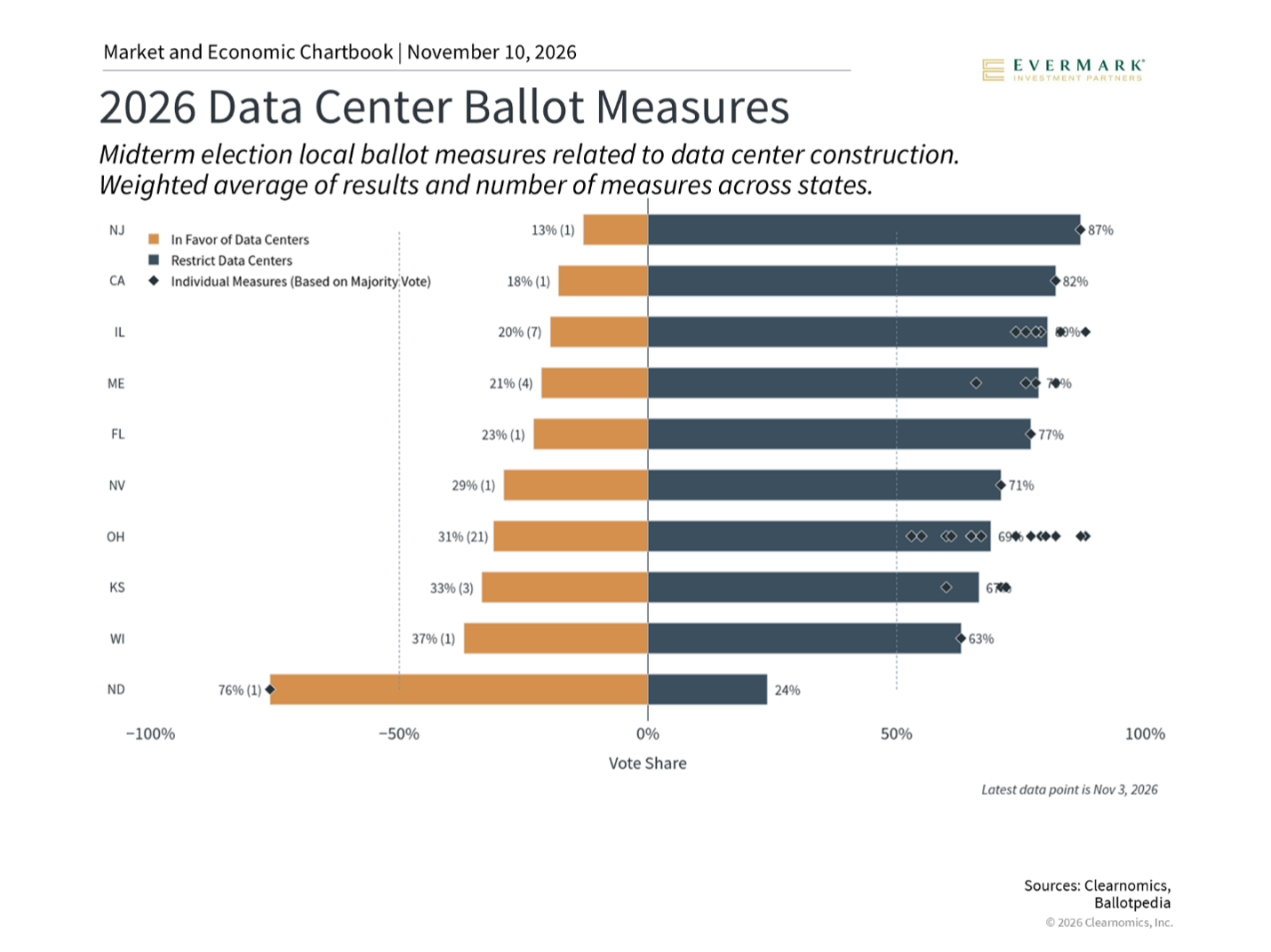
As the chart shows, voter opposition to data center construction was widespread. This year, there have been 47 local measures directly related to data centers, with 41 voted on during the midterm election across ten states.1 Voters supported restrictions on data center construction by wide margins, with only one exception.
The tension between the construction of infrastructure and the needs and desires of local communities is not new, but is accelerating due to the rapidly growing demands of AI applications.
Historical parallels include the construction of oil and gas drilling sites, which many communities have long considered by weighing environmental and quality-of-life concerns against jobs and tax revenues. The same "Not In My Backyard" (NIMBY) dynamic also occurs with highways, power plants, cell phone towers, and more. Data centers are the latest example of a large industrial buildout affecting residential communities, raising concerns about power usage, water consumption, and the scale of these facilities.
Data center construction has supported the economy
Why have data centers become such a central focus? First, it’s helpful to understand what they are. When we visit a website or app, use a search engine, send an e-mail, buy something online, or chat with an AI model, these requests are handled by servers. A data center is essentially a very large warehouse packed from floor to ceiling with servers, and can span anywhere from a few dozen to 1,000 acres. The servers run around the clock, requiring electricity, cooling, security, and more. This forms the physical infrastructure that supports all digital services, which is increasingly dominated by AI use.
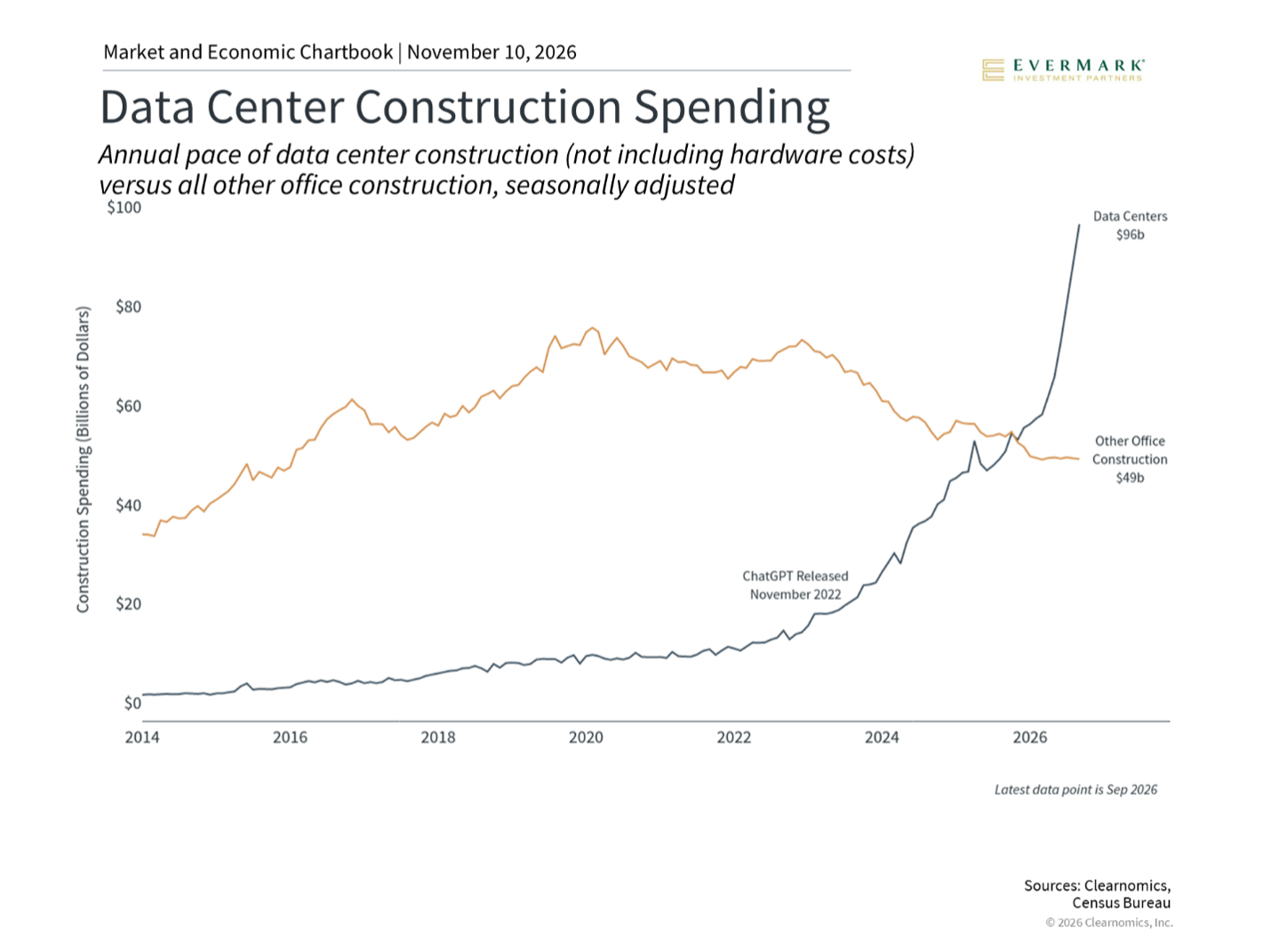
Spending on these facilities has grown in terms of its contribution to economic activity. As the chart above shows, data center construction spending, not including the hardware inside, has risen sharply since the launch of ChatGPT in late 2022. The Census Bureau estimates it has risen to $96 billion on an annualized basis, well above the roughly $49 billion spent on all other office construction.2 This buildout is one reason the gross private domestic investment component of Gross Domestic Product (GDP), which measures business spending on structures, equipment, and more, accelerated to 3.3% in the third quarter, according to the Bureau of Economic Analysis.3
It's important to distinguish between the potential long-term benefit of AI that many are hoping for, such as productivity gains, improved profit margins, and new business models, from what is currently driving AI trends. Today, it’s the physical construction of infrastructure that has been propelling economic activity and financial markets when it comes to AI.
This is similar to the railroad boom of the 19th century, where laying rail lines created jobs and demand for steel and other materials. However, this was separate from the longer-term gains that faster transportation eventually delivered to the entire economy. Restrictions on data centers may affect the pace of construction activity, but whether AI applications truly do boost productivity and provide real economic benefits is what will determine the longer-term trajectory of AI adoption.
Technology and AI stocks can be volatile
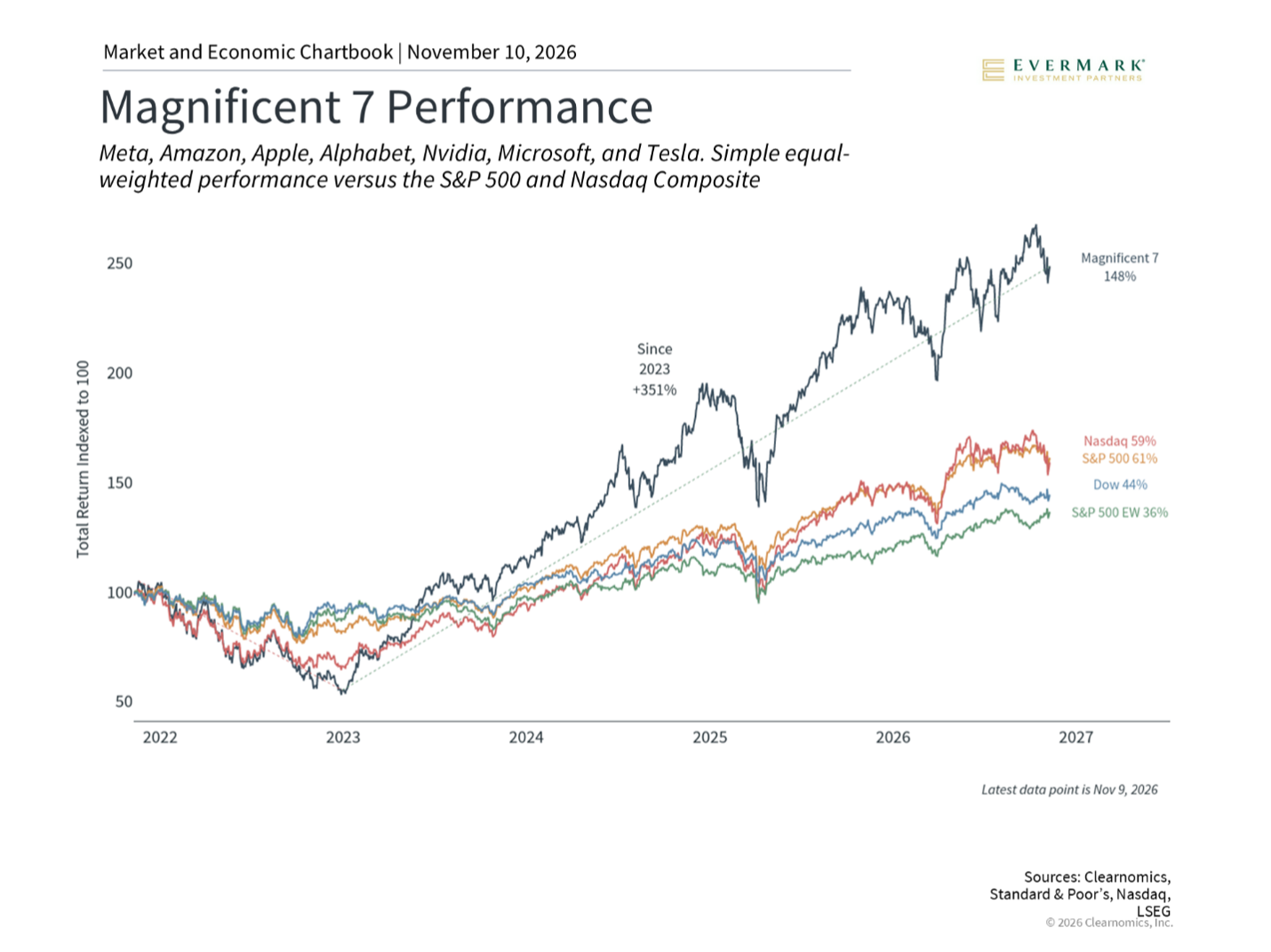
As the chart illustrates, the Magnificent 7 group of technology stocks has generated strong returns over the past several years, gaining around 140% since 2022 and rising about 340% from the start of 2023 to their recent peak, outpacing both the S&P 500 and the Nasdaq.4 However, the chart also shows significant pullbacks along the way, including the current period of volatility. In 2022, when interest rates rose rapidly, the Magnificent 7 declined by nearly 50% before recovering and going on to deliver healthy returns for long-term investors.
For investors, this is a reminder that AI is not a single investment but a long-term theme. It is still unclear whether new restrictions on data centers will be widespread and lasting, or whether economic incentives will lead more communities to support construction over time. Staying focused on a well-balanced portfolio and a long-term perspective remains the most reliable way to navigate periods like this.
The bottom line? The midterm election has raised new questions about the pace of data center construction across the country. However, recent volatility is not unusual, and maintaining a long-term perspective with a well-balanced portfolio remains the best way to navigate these periods.
References
1. Clearnomics research using Ballotpedia data, as of November 3, 2026
2. Clearnomics research using Census Bureau data, as of November 6, 2026
3. https://www.bea.gov/news/2026/gdp-advance-estimate-3rd-quarter-2026
4. Clearnomics research using Standard and Poor’s, Nasdaq, and LSEG data, as of November 6, 2026
Index Descriptions
S&P 500
The Standard & Poor’s 500 Index is a capitalization-weighted index of 500 stocks designed to measure performance of the broad domestic economy through changes in the aggregate market value of 500 stocks representing all major industries.
Dow Jones
The Dow Jones Industrial Average consists of 30 stocks that are major factors in their industries and widely held by individuals and institutional investors.
NASDAQ
The NASDAQ Composite Index measures all NASDAQ domestic and non-U.S. based common stocks listed on The NASDAQ Stock Market. The market value, the last sale price multiplied by total shares outstanding, is calculated throughout the trading day, and is related to the total value of the Index.
Securities and Advisory Services offered through LPL Financial, a Registered Investment Advisor. Member FINRA & SIPC.
This material is for general information only and is not intended to provide specific advice or recommendations for any individual. There is no assurance that the views or strategies discussed are suitable for all investors or will yield positive outcomes. Investing involves risks including possible loss of principal. No investment strategy or risk management technique can guarantee return or eliminate risk in all market environments Any economic forecasts set forth may not develop as predicted and are subject to change.
References to markets, asset classes, and sectors are generally regarding the corresponding market index. Indexes are unmanaged statistical composites and cannot be invested into directly. Index performance is not indicative of the performance of any investment and do not reflect fees, expenses, or sales charges. All performance referenced is historical and is no guarantee of future results.
This information is not intended to be a substitute for specific individualized tax or legal advice. We suggest that you discuss your specific situation with a qualified tax or legal professional.
Bonds are subject to market and interest rate risk if sold prior to maturity. Bond values will decline as interest rates rise and bonds are subject to availability and change in price.
U.S. Treasury securities are guaranteed by the federal government as to the timely payment of principal and interest. The principal value of Treasury securities and other bonds fluctuates with market conditions.
International investments carry additional risks, which include differences in financial reporting standards, currency exchange rates, political risks unique to a specific country, foreign taxes and regulations, and the potential for illiquid markets. These factors may result in greater share price volatility.
This material was prepared by Clearnomics, Inc., who is not affiliated with the named financial professional, firm or broker/dealer.
Copyright (c) 2026 Clearnomics, Inc. All rights reserved. The information contained herein has been obtained from sources believed to be reliable, but is not necessarily complete and its accuracy cannot be guaranteed. No representation or warranty, express or implied, is made as to the fairness, accuracy, completeness, or correctness of the information and opinions contained herein. The views and the other information provided are subject to change without notice. All reports posted on or via www.clearnomics.com or any affiliated websites, applications, or services are issued without regard to the specific investment objectives, financial situation, or particular needs of any specific recipient and are not to be construed as a solicitation or an offer to buy or sell any securities or related financial instruments. Past performance is not necessarily a guide to future results. Company fundamentals and earnings may be mentioned occasionally, but should not be construed as a recommendation to buy, sell, or hold the company's stock. Predictions, forecasts, and estimates for any and all markets should not be construed as recommendations to buy, sell, or hold any security--including mutual funds, futures contracts, and exchange traded funds, or any similar instruments. The text, images, and other materials contained or displayed in this report are proprietary to Clearnomics, Inc. and constitute valuable intellectual property. All unauthorized reproduction or other use of material from Clearnomics, Inc. shall be deemed willful infringement(s) of this copyright and other proprietary and intellectual property rights, including but not limited to, rights of privacy. Clearnomics, Inc. expressly reserves all rights in connection with its intellectual property, including without limitation the right to block the transfer of its products and services and/or to track usage thereof, through electronic tracking technology, and all other lawful means, now known or hereafter devised. Clearnomics, Inc. reserves the right, without further notice, to pursue to the fullest extent allowed by the law any and all criminal and civil remedies for the violation of its rights.
